

Brazilian jiu-jitsu focuses on getting an opponent to the ground in order to neutralize possible strength or size advantages through ground fighting techniques and submission holds involving joint-locks and chokeholds. On the ground, physical strength can be offset or enhanced through proper grappling techniques.
BJJ employs a wide range of takedown techniques to bring an opponent to the ground such as “pulling guard“, which is not used in other combat sports such as Judo or Wrestling. Once the opponent is on the ground, a number of maneuvers (and counter-maneuvers) are available to manipulate the opponent into a suitable position for the application of a submission technique. Achieving a dominant position on the ground is one of the hallmarks of BJJ, which includes effective use of the guard position to defend oneself from bottom (using both submissions and sweeps, with sweeps leading to the possibility of dominant position or an opportunity to pass the guard), and passing the guard to dominate from top position with side control, mount, and back mount positions. This system of maneuvering and manipulation can be likened to a form of kinetic or physical chess when executed by two experienced practitioners. A submission hold in BJJ is often assimilated to the equivalent of “checkmate”, where the opponent is left with no other option but to tap, be injured, or choked.
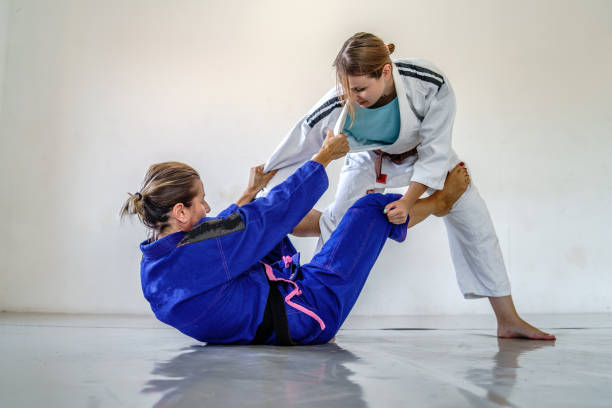
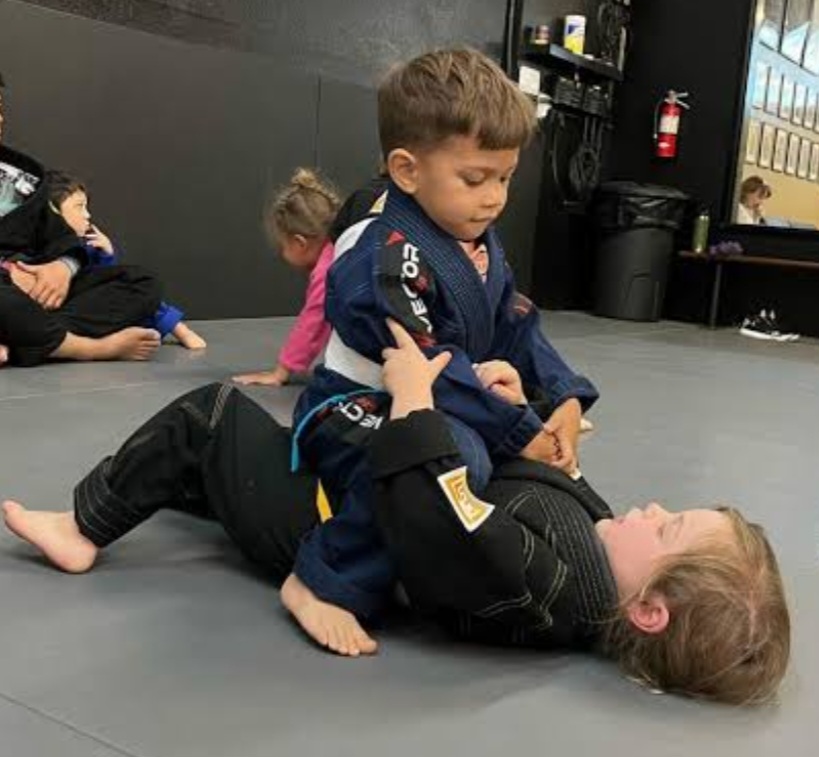
Ground fighting
A demonstration of Brazilian jiu-jitsu during a class at Standard BJJ in Rockville, MD.
Brazilian Jiu-Jitsu is mainly differentiated from other martial arts by its greater emphasis on ground fighting. BJJ places less emphasis on standing techniques, such as striking and throws, although takedowns score points and the rules allows for a diverse range of techniques such as single, double leg takedowns, or foot sweeps. Some BJJ practitioners also cross train with wrestling, judo, and sambo.
Training methods
A Brazilian jiu-jitsu instructor demonstrates how to tackle an opponent.
As BJJ focuses on submissions, sparring and live drilling become the most essential part of the training regime. This type of training allows practitioners to practice at full speed and with full strength, resembling the effort made in a competition. Training methods include drills in which techniques are practiced against a non-resisting and resisting partners; isolation sparring (commonly referred to as positional drilling) where only a certain technique or sets of techniques are used; and full sparring where each practitioner tries to submit their opponent through technique. Physical conditioning is also an important aspect of training.
The Gracie family lineage descended from Helio Gracie focuses on practical applications of BJJ that apply primarily to self-defense. They will often run development drills in which a person is surrounded by a circle of other students who will attempt to attack the defending student, who in turn must defend themselves using techniques.


